





Nitesh Tiwari’s highly anticipated film ‘Ramayana’ boasts a massive budget of ₹4,000 crore. There is immense excitement and expectation among the audience regarding this movie, as every citizen of the country holds a deep, heartfelt connection to this epic tale from Indian Sanatan culture. In this context, the film’s first song, ‘Jai Jai Ram’, was released on the auspicious occasion of Ganesh Chaturthi. However, following its release, serious questions have been raised regarding the song’s originality. The names of the artists behind this song are enough to delight any music lover: music by Oscar-winning composer A.R. Rahman, vocals by the melodious Arijit Singh and Shreya Ghoshal, and… It was expected that this powerful lyrical composition by Kumar Vishwas would create a massive impact.
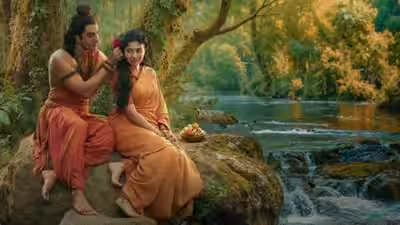
As soon as the song begins, it brings a sense of profound peace to the listener. On screen, the charming pairing of Ranbir Kapoor (Ram) and Sai Pallavi (Sita), the beautiful lanes of Ayodhya, and the visuals depicting the love story of Ram and Sita look truly magnificent. However, the song’s greatest strength has also become its biggest weakness. Firstly, it is difficult to justify starting the song with the Krishna bhajan ‘Achyutam Keshavam’. Secondly, when the familiar, classic tune of ‘Ram Siya Ram… Siya Ram Jai Jai Ram’ reaches the ears, it instantly revives childhood memories. This melody is drawn from a bhajan released in 1975—featuring the vocals of the renowned Jaspal Singh and music composed by Ravindra Jain—which has held a special place in people’s hearts for decades. The question arises: do audiences genuinely appreciate the song’s novelty, or do they like it because of the nostalgia and emotions attached to the original?
Given the massive budget of ₹4,000 crore and the involvement of a talented musician like A.R. Rahman, one expected a completely original and unique musical composition. However, by relying on an old melody, the song feels more like a ‘re-creation’ or a remake. Much like the teaser and trailer, this song attempts to encapsulate everything—from Sita’s Swayamvar and the exile to the coronation and the sacrifices made by Lakshman and Bharat—within a single track. While it served as a ‘gift’ to the audience on the occasion of Ganesh Chaturthi, the makers’ unique, original signature is not as evident here as one might have expected from such a massive film. Listening to the song certainly evokes a sense of thrill, yet it falls somewhat short in establishing the film’s own distinct voice. Had this devotional spirit been conveyed through a completely fresh melody, the impact of the first song from this ₹4,000-crore Ramayana adaptation would have been far more extraordinary.