






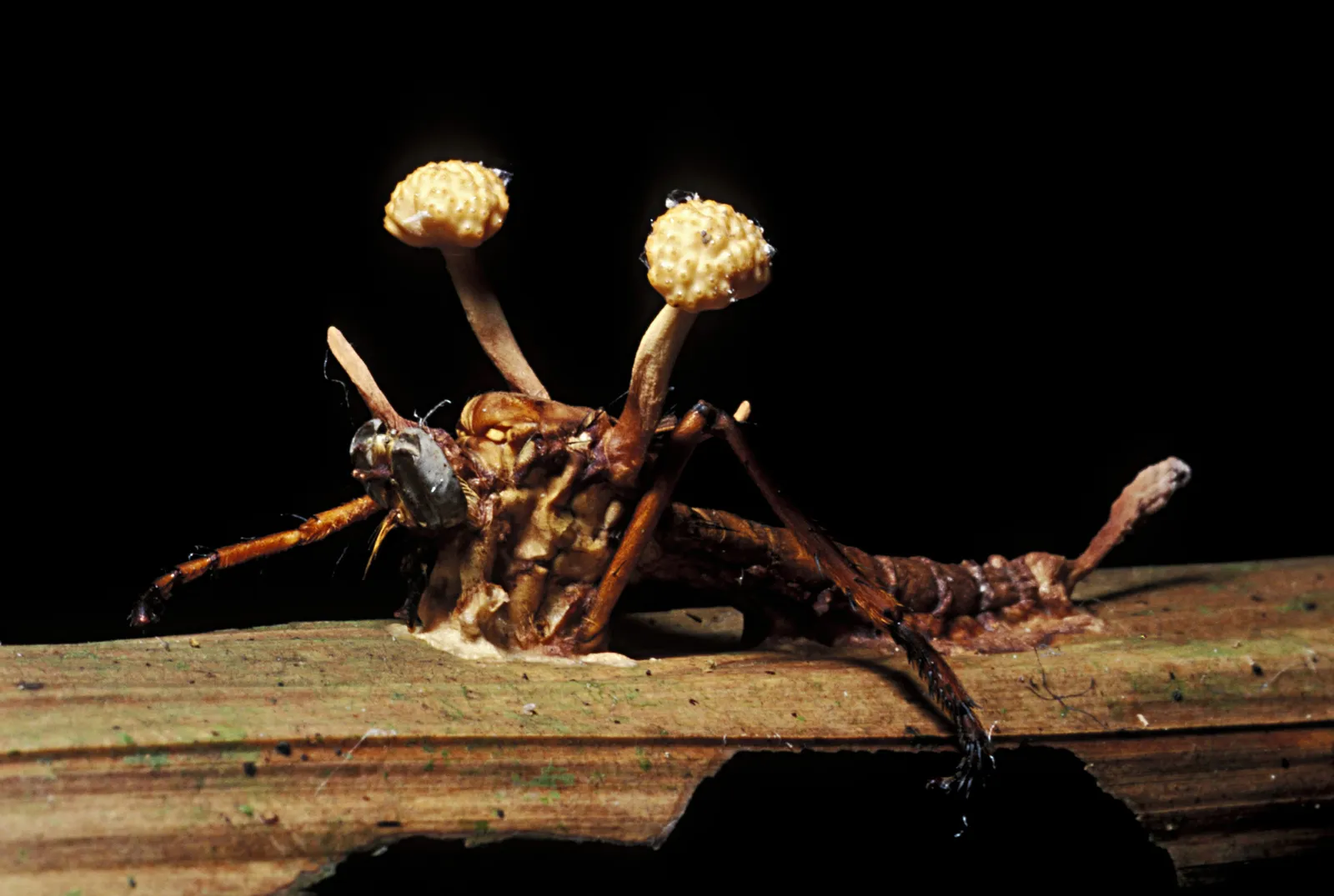
Have you ever wondered if there could be a creature around us capable of entering another organism’s body and altering its behavior? It might sound like the plot of a horror or science-fiction movie, but such phenomena actually occur in reality. Certain fungi and parasites can modify the behavior of their host organisms. Although this isn’t exactly like the ‘zombies’ seen in films, it remains a truly astonishing phenomenon for scientists.
Fungus turns ants into ‘zombies’
A prime example of this is the parasitic fungus known as Ophiocordyceps. This fungus can infect specific species of ants, and following the infection, the ant’s behavior changes. It may stray from its usual path. Eventually, the ant climbs a plant and firmly latches onto a specific spot—such as a leaf or a twig—by biting down hard. It then dies. However, the story does not end there; a fungus grows from the ant’s carcass and subsequently releases spores. These spores can infect other nearby ants. In other words, the fungus utilizes the ant’s body to complete its own life cycle. Yet, the most mysterious aspect—exactly how this fungus induces such precise behavioral changes in the ant—remains something scientists do not yet fully understand. Toxoplasma Can Also Alter an Organism’s Behavior
It is not just fungi; certain parasites can also alter the behavior of their hosts. Toxoplasma gondii is a well-known example of this. This parasite can infect mice, leading to observable changes in their behavior. Specifically, the natural fear of cats often diminishes in infected mice. This behavioral change is crucial for the parasite, as cats serve as its primary host. When a cat preys on an infected mouse, the parasite enters the cat’s body, allowing it to complete its life cycle. Toxoplasma can also infect humans and persist in body tissues for extended periods; however, research into its impact on human behavior is still ongoing. However, it is scientifically inaccurate to label Toxoplasma as a parasite that turns humans into ‘zombies’.
The case of the rabies virus is even more serious.
The rabies virus attacks the nervous system. It can cause severe symptoms in infected humans or animals, such as agitation, confusion, abnormal behavior, hallucinations, and difficulty swallowing. Consequently, the behavior of some rabies-infected animals can sometimes resemble that of ‘zombies’ seen in movies. In reality, however, this is not a case of an organism controlling the brain; it is a serious viral infection that affects the nervous system.
Can humans also become ‘zombies’?
That is the biggest question. Can a fungus or parasite take control of the human brain and manipulate a person’s actions at will? To date, researchers have found no scientific evidence to support this. Fungi like Ophiocordyceps have evolved alongside specific organisms; while they can influence the behavior of ants, this does not prove they could exert a similar effect on humans. Similarly, although Toxoplasma can infect humans, there is no evidence that it controls human behavior.
Scientists continue to study these mysterious organisms found in nature. Unraveling this mystery will not only expand our understanding of the natural world but could also aid in the future development of new medicines, treatments, and biological control methods. The ‘Joe’ depicted in the film is fictional; however, fungi and parasites that influence the behavior of other organisms in nature are real. For this reason, the natural world is no less mysterious than science fiction films.