





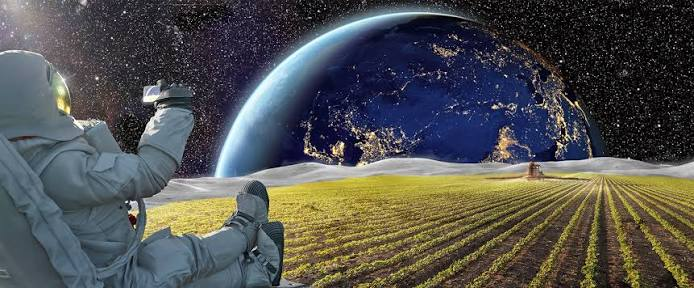
As humans prepare for long-duration missions to the Moon and Mars, food production in space is becoming a crucial aspect of space exploration. The goal of space agriculture is to provide astronauts with fresh, nutritious food, thereby making them more self-reliant so they do not have to depend solely on supplies sent from Earth.
Transporting large quantities of packaged food from Earth to space is extremely expensive, a challenge that is further compounded for long-term missions. Consequently, space agencies such as NASA, ISRO, and China’s space agency are working on methods to cultivate crops sustainably in space. The Need for Space Agriculture
Such experiments are already being conducted on space stations. Indian-origin NASA astronaut Anil Menon cultivated kale and wasabi mustard on the International Space Station. Similarly, Chinese astronauts successfully cultivated rice on the Tiangong space station. These experiments help scientists understand how plants behave in microgravity and how crops can be grown under highly controlled conditions.
How is farming done in space?
Farming in space is completely different from traditional farming on Earth. There is no ordinary soil, sunlight, or gravity here. Instead, astronauts use systems specifically designed to meet the needs of the plants.
Seeds and Nutrients
Rather than using ordinary soil, astronauts use special seeds that contain the nutrients necessary for plant growth. These systems allow the seeds to grow in a controlled environment while also providing them with the required nutrients.
LED Lights
Since natural sunlight is not readily available for controlled space farming, special red and blue LED lights are used. These lights provide the wavelengths necessary for photosynthesis and help grow plants inside the space station.
Water Recycling
Water is one of the most valuable resources in space. Therefore, plants are cultivated using carefully controlled irrigation systems. Water can be recycled and reused, which minimizes waste.
Can Aid Missions to the Moon and Mars
Space agriculture could play a pivotal role in future deep-space missions. If humans establish long-term settlements on the Moon or Mars, transporting all food supplies from Earth would be prohibitively expensive and difficult. If they can produce some of their own food there, these missions could become more sustainable.
Plants can also contribute to life-support systems. They absorb the carbon dioxide exhaled by astronauts and produce oxygen through photosynthesis. This can help create a natural cycle for air recycling.
What are the benefits beyond food?
The importance of space agriculture is not limited to nutrition and oxygen alone. The presence of fresh food and growing plants during stressful missions can also improve the astronauts’ mental health. This technology could also make agriculture on Earth more profitable in the future. It enables the development of methods for cultivating crops with minimal water, controlled nutrients, and in harsh environmental conditions. It can assist farmers in growing food in arid or barren regions.
How might space agriculture shape the future?
The future of space agriculture could extend far beyond just vegetables and leafy greens. Scientists could also work on various other crops and food sources, such as lab-grown meat. As space missions extend in duration and human settlements venture further from Earth, the ability to produce food locally will become as critical as power generation and water recycling. This could transform space agriculture from a mere scientific experiment into a vital technology for sustaining human life beyond Earth.