






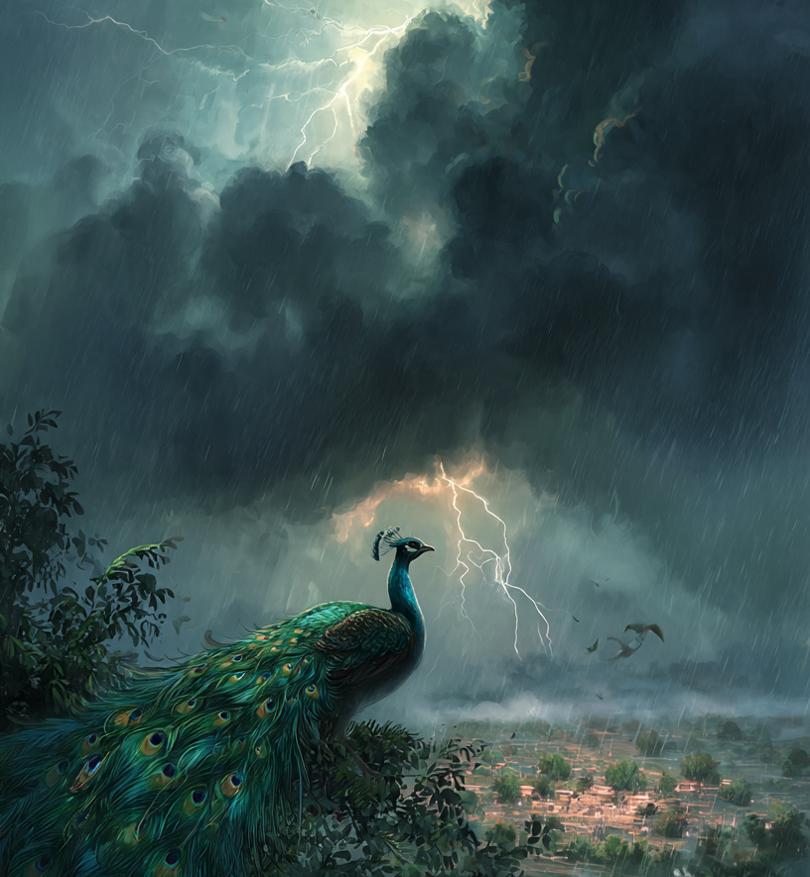
In Odia, we call the thunderous sound that comes from the sky after the intense heat of summer ‘Megh Mahlar’. The word ‘Mahlar’ means roar or roar. From the beginning of the month of Asada, dark clouds slowly advance from the southwest. There is a rumbling sound, then lightning flashes. A cool wind blows and blows away the dust. The leaves of the trees dance and cry. All these scenes are part of Megh Mahlar. Megh Mahlar is not just a sound, it is a sure sign of the arrival of rain. It is a vital message for the farmers. Megh Mahlar is the news of the first drop of water falling on the open fields that they have been waiting for all year. Farmers run to the fields with their ploughs, mothers sprinkle the first water that falls under the mango trees and put it on their heads, children run to play in the rain.
Megh Mahlar brings coolness, joy, and new hope. Science says that before rain, there is a change in temperature and pressure in the atmosphere, which takes the form of thunder. But for us, it is not just science, it is a feeling. The great poet Kalidas, in his poem ‘Meghadoot’, sent the message of a lost lover by making clouds into angels. Odia folk songs also describe Megha Mahla – “Black clouds covered the sky, thunder became the Mahla”. Upon hearing Megha Mahla, our national bird, the peacock, also flutters and performs a dance with its wings spread. The peacock dance and Megha Mahla together bring the rainy season to its fullness. In Hinduism, clouds are worshipped as gods. According to Puranas, Indra is the god of rain. Megha Mahla is the drum of his arrival. There is a lot of evidence, including folk tales, that rain comes when young singers or seekers sing Megha Mahla. Odisha is an agricultural state. The Mahanadi, Brahmani, and Baitarani rivers here are filled with rainwater and carry the lifeboats of millions of farmers. If the cloud does not come at the right time, there is a drought, crops are destroyed. Therefore, the place of the cloud is very high in our culture. The cloud teaches us the lesson of renunciation. The cloud itself holds water and rains on everyone equally and then becomes empty. It does not discriminate between king and people, rich and poor. It teaches us that selfless service to the society is the best religion. Nowadays, due to pollution and climate change, the cloud does not come at the right time. Sometimes there is a lot of rain and there is a flood, sometimes there is no rain and there is a heat wave. Due to deforestation, the formation of clouds is decreasing. Therefore, it is our duty to protect the environment. Plant more trees, stop deforestation. If there is a cloud, then the Mahlar can be heard. If the Mahlar is heard, it will rain, and if it rains, Mother Earth will turn brown. Finally, it can be said that the cloud Mahlar is the music of the sky. When nature hears that music, life wakes up, hope wakes up. Let us all try to keep nature green by respecting the Megh Mahal, so that our future generations can also enjoy the roar of the Megh Mahal.